
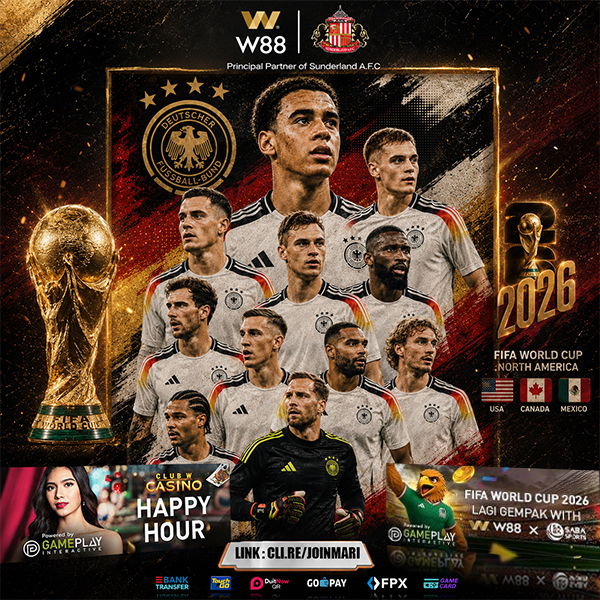
The German national team arrives at the 2026 World Cup with a clear sense of purpose: to re-establish itself among football’s global elite. After back-to-back group-stage exits in 2018 and 2022, Die Mannschaft enters this tournament under Julian Nagelsmann carrying both pressure and expectation in equal measure.
Nagelsmann has implemented a dynamic, fluid system that draws inspiration from Germany’s most successful eras in 1974 and 2014—both built on a strong core of Bayern Munich players. The principle is straightforward: To build team chemistry through familiarity, while shaping a modern system that can adapt under pressure.
The Bayern Backbone
After a disappointing 0–2 defeat to Slovakia in a World Cup qualifier match, Germany responded with a commanding 6–0 victory in the return match to secure top spot in the group. Nagelsmann was quick to emphasize that emotion, intensity, and courage remain non-negotiable—arguing that structure alone will not carry a team through a tournament of this magnitude.
At the heart of this setup lies a Bayern Munich-heavy spine. Jonathan Tah, Aleksandar Pavlović, Joshua Kimmich, Leon Goretzka, and Jamal Musiala provide the structural foundation of the side. Their familiarity at club level translates into immediate cohesion, allowing Germany to operate with a level of synchronisation that is difficult to replicate in international football.
Still, uncertainties remain. Musiala has shown flashes of inconsistency in form, while Kimmich may again be asked to fill in at right-back despite his preference for a central midfield role. Even so, his tactical intelligence and adaptability remain crucial—offering Nagelsmann a rare ability to reshape the team’s structure without altering personnel.
Wirtz–Musiala: Germany’s Creative Engine
If Germany’s 2014 World Cup-winning side was defined by Toni Kroos and Mesut Özil, the 2026 version is increasingly shaped around Florian Wirtz and Jamal Musiala. Together, they represent the creative heartbeat of this new generation—capable of breaking lines, manipulating tight spaces, and deciding matches in moments of individual brilliance.
Wirtz, in particular, has emerged as a central figure in Nagelsmann’s system. His vision, technical precision, and relentless off-ball work make him more than a traditional playmaker—he is the connector between structure and chaos in Germany’s attacking play. Alongside Musiala, he forms the creative axis through which much of Germany’s offensive threat flows.
Beyond the established stars, Lennart Karl has begun to attract attention as a potential breakout figure. While still raw at international level, his rise adds another layer of intrigue to a squad already defined by its blend of experience and emerging talent.

Germany’s Striker Dilemma and Neuer’s Return
One of Germany’s most persistent tactical questions remains the absence of a natural, world-class number nine. As a result, Nagelsmann is expected to lean on Kai Havertz in a false nine role—prioritizing fluid movement and positional interchange over a fixed attacking reference point.
Niclas Füllkrug and Nick Woltemade remain alternative options, but neither has fully established himself at elite international level. That reality places even greater creative responsibility on Germany’s attacking midfielders to generate goals in moments of structure-breaking invention.
Meanwhile, the recall of Manuel Neuer has sparked inevitable debate. The Bayern Munich veteran initially retired from international football after Euro 2024 before being brought back into the fold. His experience, leadership, and command of the penalty area are unquestioned—but questions linger over durability across the intensity of a World Cup campaign.
Oliver Baumann, who played a key role during Germany’s qualification journey, now finds himself in direct competition for the starting position. It is one of Nagelsmann’s boldest and most scrutinized decisions heading into the tournament.
The Mission to Restore German Authority
Beyond results and silverware, the 2026 World Cup represents something more fundamental for Germany: a chance to rebuild identity. Nagelsmann’s objective is to revive the core principles that have long defined German football—discipline, intensity, structural clarity, and psychological resilience under pressure.
With a blend of experienced leaders such as Neuer, Kimmich, and Goretzka, alongside a new generation led by Wirtz and Musiala, Germany enters the tournament with a squad that is both balanced and in transition. Questions remain—particularly in the striker position—but the overall profile is still that of a serious contender.
Ultimately, Germany’s trajectory will depend on Nagelsmann’s ability to fuse structure with spontaneity, and experience with youth, into a coherent competitive identity. If that balance is achieved, Die Mannschaft may once again reassert itself not just as a contender—but as a defining force on football’s biggest stage.
Contact Us :
LiveChat : W88 Malaysia
Telegram: W88Malaysia